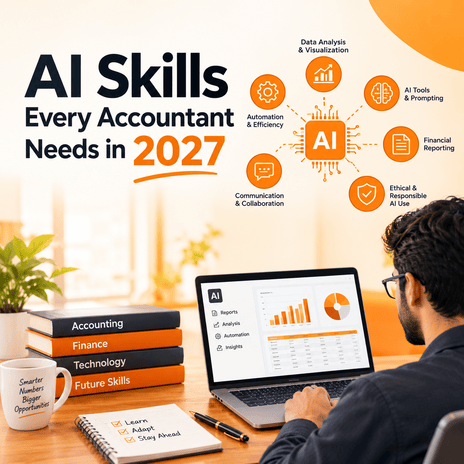
The AI skills for accountants that matter most in 2027 are AI literacy, prompting for finance work, data analysis, basic data science, automation and ERP systems, reviewing AI output with professional scepticism, AI ethics and client confidentiality, and the ability to turn AI output into sound advice.
Most finance teams have already started. In ACCA’s Global Talent Trends 2026 survey of 11,389 professionals across 160 countries, 52% said they use AI tools regularly at work. Employers are rewarding it too: Robert Half’s 2027 Finance and Accounting Salary Guide reports that 82% of finance and accounting leaders offer higher pay for relevant AI skills.
So the question for a student or junior accountant is not whether to learn these skills, but which ones and how. Let’s get into it.
8 AI Skills for Accountants in 2027
Here are the eight skills that come up again and again, both in what employers ask for and in the design of ACCA’s.
1. AI Literacy and Tool Fluency
Start with a working understanding of how AI tools behave. Generative AI predicts likely answers; it does not look facts up the way a database does. That is why it can sound completely sure of itself and still be wrong. Once you understand this, you can judge which tasks to hand over and which to keep. Aim to be at ease with general assistants like ChatGPT and Microsoft Copilot, and with the AI features already built into most accounting software.
2. Prompting for Finance Tasks
The quality of an AI answer depends heavily on the instruction behind it. A strong prompt sets out the role, the data, the output you want, and the checks the tool should apply. For example:
“You are a management accountant. Below is this month’s actual vs budget for revenue and costs by department. Identify the three largest variances, suggest likely reasons for each, and write a 100-word summary for the finance director. Flag any figure you are unsure about instead of guessing.”
Compare that with “explain these variances,” and the difference in output is obvious.
3. Data Literacy and Analysis
Poor data produces poor AI output every time. Accountants need to clean a dataset, notice when something looks off, build a dashboard, and explain a trend to someone who is not a numbers person. Advanced Excel, Power Query, and Power BI do most of the heavy lifting here. For many students, an online Microsoft Power BI Course is the fastest route from static spreadsheets to interactive financial dashboards.
ACCA covers this ground in F3 Decision Making with Data and E5 Performance with Data Analysis.
4. Data Science Basics
Accountants do not need to become software developers. A little Python or SQL, though, goes a long way: it lets you automate tedious data cleaning, work with files too large for Excel and follow what an AI model is actually doing. A beginner-level Python programming course is usually enough to write simple scripts and hold your own with data teams.
For students who want to go further, ACCA has introduced a Data Science Professional option at the Strategic Professional level.
5. Process Automation and ERP Systems
A large share of finance work now runs through ERP platforms and automated workflows. If you understand how a transaction travels through those systems, you can improve the process, set up automation, and supervise AI agents that handle routine steps. Robert Half lists ERP proficiency among the skills attracting higher pay.
6. Professional Scepticism When Checking AI Outputs
AI tools can get figures wrong, cite sources that do not exist, and miss context a human would catch. Checking their work means tracing numbers back to source data, retesting a sample of AI-coded transactions, and recording what you reviewed.
For trainees, this may be the most important skill of all. Entry-level roles are moving away from producing the numbers and towards reviewing work that AI has produced. A junior who can spot what does not add up is far more useful than one who simply accepts the output.
7. AI Ethics, Governance, and Client Data Confidentiality
Think before pasting client information into any AI tool. Where is that data stored? Who can access it? Is the tool approved by your firm? Ethical AI use also means watching for bias in automated decisions and being able to explain how an AI-assisted conclusion was reached.
Ethics remains central to ACCA. Under the new structure, the Ethical, Sustainable Leadership module is a requirement at Strategic Professional level.
8. Turning AI Output Into Advice
A report can now be generated in seconds. What a client or manager needs is someone who can tell them what it means and what to do about it. Clear communication, storytelling with data, and commercial awareness turn output into decisions, and this is where accountants earn their fees.
How to Start Building AI Skills as an ACCA Student
There is no reason to wait until you are qualified. At Knowledge level, get used to AI assistants as a revision aid and sharpen your Excel, but always check their answers against your study material. Once you reach Expertise, learn Power BI, practice reviewing AI-coded transactions, and use E5 and the Digital Tech and Innovation module to link data with performance. By Strategic Professional, the focus shifts to judgement, ethics, and advice, and the Data Science Professional option is worth considering if a data-led career appeals to you.
One habit applies at every stage: question what the AI gives you. It is exactly what employers now expect from trainees.
Where the 2027 ACCA Qualification Teaches These Skills
ACCA says the future qualification brings “even more focus on sustainability, social impacts, AI and technology, all woven into the qualification.”
| Skill | ACCA exam or module | Level |
| Decision-making with data | F3 Decision Making with Data | Foundations |
| Data analysis | E5 Performance with Data Analysis | Expertise |
| Digital technology | Digital Tech and Innovation module | Expertise |
| Data science | Data Science Professional (option) | Strategic Professional |
| Ethics | Ethical, Sustainable Leadership module | Strategic Professional |
New-structure exams begin in July 2027 for Foundations and Knowledge and September 2027 for Expertise and Strategic Professional. Our guide to the major ACCA changes coming in 2027 covers the full details.
At Mirchawala’s Hub of Accountancy, you can study ACCA through onsite classes or online recorded lectures and build data skills such as Power BI and Python alongside your qualification.
Conclusion
AI skills for accountants have moved from “nice to have” to part of the job description. The accountants who will stand out in 2027 are those who pair AI literacy, data skills, and automation with the judgement, ethics, and communication that software cannot supply. ACCA has redesigned its qualification around that combination, and employers are already paying more for it. Starting now puts you ahead of the change instead of behind it.
Frequently Asked Questions
Is ACCA still worth it with AI?
Yes. AI handles routine tasks well, but organisations still need qualified accountants for judgement, ethics, audit opinions, and advice. The 2027 ACCA Qualification also builds data, AI, and technology content into the syllabus, so students develop these skills while they qualify.
Which AI skill should accountants learn first?
AI literacy and data analysis. Understand how AI tools work and where they tend to go wrong, then build solid Excel and Power BI skills. Everything else builds on that base.
Do ACCA exams test AI skills?
The 2027 qualification brings data and technology into both exams and modules, including F3 Decision Making with Data, E5 Performance with Data Analysis, the Digital Tech and Innovation module, and the new Data Science Professional option.
Can accountants use ChatGPT safely?
Yes, provided you follow your firm’s policy, keep confidential client data out of unapproved tools, and verify every figure and reference before using the output.
Do accountants need to learn coding?
Not at an advanced level. Basic Python or SQL helps with large datasets and automation, but for most accountants the biggest gains come from Excel, Power BI, and well-written AI prompts.