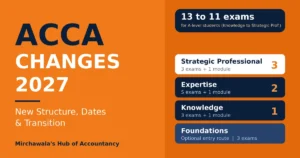
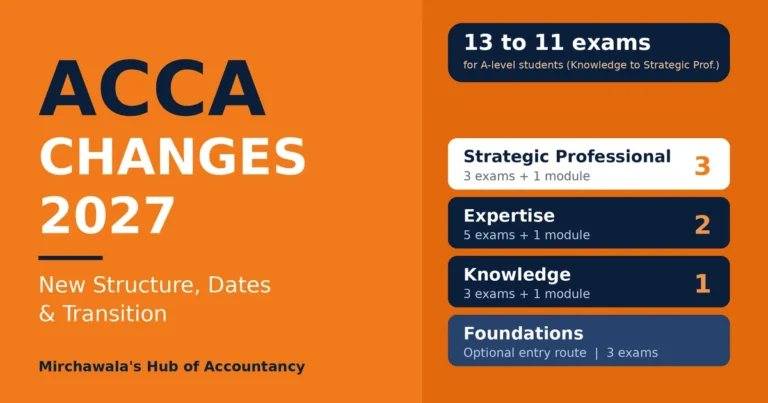
ACCA is redesigning its qualification, with the new exams starting in mid-2027. The qualification has three levels, Knowledge, Expertise, and Strategic Professional, with an optional Foundations route for students who don’t meet the entry criteria. By our count the number of exams in the three main levels falls from 13 to 11.
Each level also includes a compulsory Essential Employability Module. Until the switch, current exams continue under the current structure, with the final session-based Applied Skills and Strategic Professional exams in June 2027.
If you are planning to study the online ACCA qualification, this guide explains what changes, what stays the same, and how to plan your exams around the transition.
Why is ACCA changing its qualification?
ACCA is the Association of Chartered Certified Accountants, a global professional accountancy body. It says the ACCA qualification redesign responds to the changing needs of business: more focus on sustainability, social impact, and AI and technology, with ethics remaining at the heart of the qualification. ACCA announced the redesign on 25 June 2025.
The qualification is not being thrown away. Financial reporting, audit, tax, management accounting, and strategy all remain. What changes is the structure, the emphasis on data and sustainability, and the way employability and professional skills are taught and assessed.
What are the 2027 ACCA Qualification Changes?
ACCA calls the redesign “Accountancy Redefined.” It changes four things.
- Fewer exams: 11 across Knowledge, Expertise, and Strategic Professional instead of 13, numbered in a recommended order (a guideline, not a rule)
- Essential Employability Modules (EEMs): Interactive online modules with built-in assessment, one at each level.
- New awards: A diploma at each stage, not only at the end.
- More technology, AI, and sustainability: Woven through the syllabus, plus a new Data Science Professional option
The EEMs are not a direct replacement for the ACCA Ethics and Professional Skills Module (EPSM). ACCA says they differ in content, learning experience, time required, and progression rules. EPSM and Foundations in Professionalism will not be part of the redesigned qualification.
When does the new online ACCA qualification start?
Note: ACCA’s March and September sessions offer only limited variants of the Applied Skills and Strategic Professional exams. All variants are available in June and December. Check variant availability before planning a March 2027 sitting. For December 2026, exams run 7–11 December, with standard entry closing on 2 November and late entry on 9 November.
What is the ACCA new qualification structure?
| Level | Exams | Essential Employability Module |
| Foundations (entry route) | F1 Accounts Preparation, F2 Management Information and Costing, F3 Decision Making with Data | Enterprise and Entrepreneurship |
| Knowledge | K1 Financial Accounting, K2 Management Accounting, K3 Business Law | Responsible Business Management |
| Expertise | E1 Taxation, E2 Financial Reporting, E3 Audit, Risk and Control, E4 Finance and Investment, E5 Performance with Data Analysis | Digital Tech and Innovation |
| Strategic Professional | S1 Business and Sustainability Reporting, S2 Strategic Business Leader, plus one Options exam | Ethical, Sustainable Leadership |
Applied Knowledge becomes Knowledge, and Applied Skills become Expertise. Strategic Professional keeps its name. Law moves down to Knowledge, and Business Technology no longer appears as a standalone exam.
Students progress through the levels in order and must enter all outstanding exams and the module at their level before moving up. Within a level, exams and the module can be taken in any order.
Who Takes the 11 Exams and Who Starts with Foundations?
The redesigned ACCA qualification has 11 exams for students who enter the main qualification directly. These are divided across the Knowledge, Expertise and Strategic Professional levels.
Students who do not meet ACCA’s direct entry requirements can start through the separate Foundations route, which has three exams. After completing Foundations, students can progress to the Knowledge level and continue through the main qualification.
| Student route | What happens |
| Meets ACCA’s entry requirements | Starts at Knowledge and progresses through the 11-exam main qualification |
| Does not meet the direct entry requirements | Starts with 3 Foundations exams, then progresses to Knowledge |
| Current ACCA student | Continues under the current structure or follows ACCA’s transition rules based on their completed exams |
Important: The three Foundations exams are separate from the 11 exams in the main redesigned qualification. A student who starts with Foundations and then completes the entire main qualification would therefore complete the Foundations exams in addition to the 11 main qualification exams.
The current qualification is different. Before the 2027 redesign, students following the main ACCA route complete 13 exams across Applied Knowledge, Applied Skills and Strategic Professional. The redesigned main qualification reduces this to 11 exams.
How Do the ACCA Changes Affect Matric, Intermediate, O-Level, and A-Level Students?
Your school qualification decides where you enter ACCA, and that decides how the 2027 changes affect you. Here is how the four qualifications compare, followed by what each means for you.
Matric vs. Intermediate vs. O-Level vs. A-Level
| Qualification | Stage | Grades | Awarded by |
| Matric (SSC) | Secondary | 9–10 | Pakistani boards |
| O-Level | Secondary | Around 9–11 | Cambridge (O-Level) or Pearson Edexcel (IGCSE) |
| Intermediate (HSSC) | Higher secondary | 11–12 | Pakistani boards |
| A-Level | Higher secondary | AS and A2 (two years) | Cambridge or Pearson Edexcel |
Matric and Intermediate are the local board routes. O-Level and A-Level are the international routes. Intermediate and A-Level sit at the same stage, and that is the stage ACCA’s direct entry is built around.
If You Have Matric
- Likely starting point: Foundations (ACCA sets no minimum entry requirements at this level)
- What changes: The new Foundations exams (F1, F2 and F3) and the Enterprise and Entrepreneurship module begin in July 2027
- Timing: Start before July 2027, and you follow the current structure and transition rules. Start after, and you follow the new one. Check ACCA’s transition guidance for how your Foundation-level progress carries over.
If You Have O-Level
- Likely starting point: Foundations
- What changes: The same as Matric
- Another option: Adding two A-Levels to your O-Levels can give you direct entry, provided your five subjects include English and maths. Compare that timeline with the July 2027 launch before you decide.
If You Have Intermediate
- Likely starting point: Knowledge of the relevant subjects, otherwise foundations.
- What changes: If you finish around mid-2027, you will most likely start on the new Knowledge exams (K1, K2 and K3) rather than the current Applied Knowledge papers
- Before you plan: Have your subjects checked against ACCA’s entry requirements for Pakistan
If You Have A-Level
- Likely starting point: Knowledge (direct entry), if you hold two A-Levels and three O-Levels (or equivalent) in five separate subjects, including English and maths
- Why it matters: Your start date decides which structure you follow, so you have two options:
| Your plan | What it means |
| Start now | You follow the current Applied Knowledge structure. Pass FA, MA, BT, and Foundations in Professionalism by mid-July 2027 to earn the current Diploma in Accounting and Business and skip the Responsible Business Management module (about 60 hours, chargeable). |
| Start after your A-Levels in mid-2027 | You most likely begin on the new Knowledge level from July 2027 once your results are in. Business Technology is no longer a standalone exam, and your first module is Responsible Business Management. |
The new Expertise exams begin in September 2027, so a July 2027 start leaves time to finish Knowledge first.
A Note on Entry Requirements
Entry requirements depend on your subjects, grades, and country, and ACCA can update them. Confirm your position on ACCA’s official entry requirements and in its transition tool before you enrol.
What are the new subjects and ACCA syllabus changes?
The one genuinely new exam is Data Science Professional (SDS), a new strategic professional option. Several other papers have been redesigned with a stronger data or sustainability focus:
- Performance with Data Analysis (E5): a compulsory expertise exam, which replaces Performance Management in ACCA’s transition mapping
- Decision Making with Data (F3): the data exam at Foundations
- Business and Sustainability Reporting (S1): the core strategic professional reporting exam, with sustainability added
Strategic Professional now requires two core exams and one Options exam instead of the current two. The five options are Audit and Assurance Professional (SAA), Corporate Finance Professional (SCF), Data Science Professional (SDS), Performance and Insights Professional (SPI), and Taxation Advisory Professional (STA). Some countries have extra requirements for audit licenses, so students in those markets may still need more than one option.
ACCA has published guidance packs for every level, containing syllabi, specimen exams, and specimen answers. Local variants continue for K3 Business Law, E1 Taxation, and STA Taxation Advisory Professional.
What are Essential Employability Modules?
EEMs are interactive online modules with formative and summative assessment, covering business fundamentals, entrepreneurship, AI and technology, ethics, and sustainability. They are mandatory at each level and are chargeable, with prices to be confirmed (ACCA said January 2027).
They are not short. ACCA’s transition guidance estimates roughly:
- Responsible Business Management: about 60 hours
- Digital Tech and Innovation: about 100 hours
- Ethical, Sustainable Leadership: about 60 hours
For comparison, EPSM takes about 20 hours. Exemptions are available for the Responsible Business Management module for students with relevant prior learning, but not for Digital Tech and Innovation or Ethical, Sustainable Leadership.
ACCA also offers optional employability modules. It plans to let up to six months of the 36-month ACCA Practical Experience Requirement (PER) be met through certain ones, but not from September 2027. Timing is to be confirmed. Simulated experience will not count toward the UK audit qualification, practicing certificates, or performance objectives.
How do current ACCA papers map to the new structure?
This mapping comes from ACCA’s own transition guidance. Check your own position in ACCA’s transition tool.
| Current paper | New exam |
| Financial Accounting (FA) | K1 Financial Accounting |
| Management Accounting (MA) | K2 Management Accounting |
| Business and Technology (BT) | No exam equivalent (see below) |
| Corporate and Business Law (LW) | K3 Business Law |
| Taxation (TX) | E1 Taxation |
| Financial Reporting (FR) | E2 Financial Reporting |
| Audit and Assurance (AA) | E3 Audit, Risk and Control |
| Financial Management (FM) | E4 Finance and Investment |
| Performance Management (PM) | E5 Performance with Data Analysis |
What happens to current ACCA students?
Passed papers carry over where an equivalent element exists in the redesigned qualification, and ACCA says existing achievements will be recognised. What you should do depends on your level.
Applied Knowledge
- You move to the knowledge level and keep credit for FA and MA.
- BT has no exam equivalent. If you haven’t passed it before transition, you must take the Responsible Business Management module (about 60 hours, chargeable).
- To get the current ACCA Diploma in Accounting and Business, finish FA, MA, BT, and Foundations in Professionalism by mid-July 2027
- ACCA suggests taking LW as your first applied skills exam, since it is available on demand.
Applied Skills
- Your remaining session-based sittings are December 2026, March 2027, and June 2027, and LW variants can be taken on demand until July 2027
- To get the Advanced Diploma under current rules, you must complete all Applied Skills exams in or before the June 2027 session (LW variants can run to July 2027) and EPSM by mid-July 2027. Completing EPSM by this deadline gives credit for the Ethical, Sustainable Leadership EEM.
- If you don’t finish every Applied Skills exam (including LW) before transition, you will need the Digital Tech and Innovation module (about 100 hours, chargeable), which must be purchased before you can enter Strategic Professional exams.
- Anyone who hasn’t passed LW must enter K3 Business Law before or at the same time as the Expertise exams.
Strategic Professional
- Current rules require both Essentials and two Options until June 2027. From September 2027, only one option is required.
- If you hold credit for both Essentials, one Option, and the Ethical, Sustainable Leadership module (which EPSM gives you credit for), you receive the Strategic Professional Certificate.
- Any student who has not completed EPSM by mid-July 2027 will need to complete the Ethical, Sustainable Leadership module (approximately 60 chargeable hours) in order to become an affiliate. Existing affiliates keep their affiliate status but will need to complete the module to become a member. ACCA’s guidance includes a footnote that EPSM is not mandatory for the Certificate, so please use Mid-July 2027 transition tool to check where you stand.
Exemptions
- ACCA says its exemptions calculator will be updated in July 2027 to reflect the redesigned qualification.
- Exemptions remain available at Knowledge and Expertise (and for Foundations exams, for students who start there). Exemptions are not available at Strategic Professional.
What awards will ACCA students earn?
| Award | What you complete |
| Diploma in Accounting and Business | Three Foundations exams + Enterprise and Entrepreneurship module |
| Higher Diploma in Accounting and Business | Three Knowledge exams + Responsible Business Management module |
| Advanced Diploma in Accounting and Business | Five Expertise exams + Digital Tech and Innovation module |
| The ACCA Qualification | Three Strategic Professional exams + Ethical, Sustainable Leadership module + PER |
Where a student has exemptions, a minimum number of exams must still be passed to earn an award: at least one exam at Foundations and Knowledge, and at least two at Expertise.
Should you start the ACCA now or wait for 2027?
ACCA encourages students to continue to study and not defer their studies as passes under the current structure will be recognised. As far as progressing through the ACCA new syllabus 2027 is concerned, the question is whether one is able to complete a level before the transition. If so, then the extra module and associated complexities of the transition at that level can be avoided. If not, then nothing that has been passed is lost, but take into account the hours and cost of a module that may have to be taken.
Does the redesign change how you study the ACCA online?
The employability modules are delivered online, so online study continues, but the content changes. You will need tutors and materials updated for the 2027 syllabi, and ACCA’s guidance packs give the best view of what the ACCA exams changes look like.
Conclusion
The 2027 ACCA qualification redesign brings a new exam structure, Essential Employability Modules and greater focus on data, technology and sustainability. For students pursuing an qualification from online ACCA institute, understanding the transition dates is important.
Current students will retain recognised passes, but some may need to complete additional modules. Check your remaining exams and use ACCA’s transition tool to confirm your individual requirements.
Have questions about the new ACCA structure 2027 or your transition? Contact Mirchawala Hub of Accountancy for guidance.
FAQs
What is changing in ACCA?
The three main levels go from 13 exams to 11, with Essential Employability Modules, including new awards and a greater emphasis on data, AI and sustainability.
What are the ACCA new subjects?
Data Science Professional is the new exam. Performance with Data Analysis, Decision Making with Data and Business and Sustainability Reporting are redesigned papers with a stronger data or sustainability focus.
Is ACCA changing in 2026?
Not yet. The redesign was announced in 2025 and the first new exams are to be held from July 2027, so 2026 sittings will take place under the current structure.
What is the new ACCA qualification structure?
Foundation (entry route) Knowledge Expertise and Strategic Professional with 3, 3, 5 and 3 exams respectively all paired with an Essential Employability Module.
Will the ACCA syllabus change in 2026?
The new syllabi are implemented in relation to exams taking place from July and September 2027. Exams currently in progress will continue to be governed by the existing structure until June 2027. Please consult ACCA’s exam notices for any revisions to individual current papers.
Are ACCA exams changing?
Yes. The number of exams falls, they get new codes and a recommended order, and Data Science Professional is added as an option.
When will the new ACCA syllabus start?
July 2027 for Foundations and Knowledge, September 2027 for Expertise and Strategic Professional.
What happens to current ACCA students?
Passed papers and exemptions carry across. Some students will need to take an Essential Employability Module, depending on which papers they have completed before transition. Use ACCA’s transition tool to see your exact position.