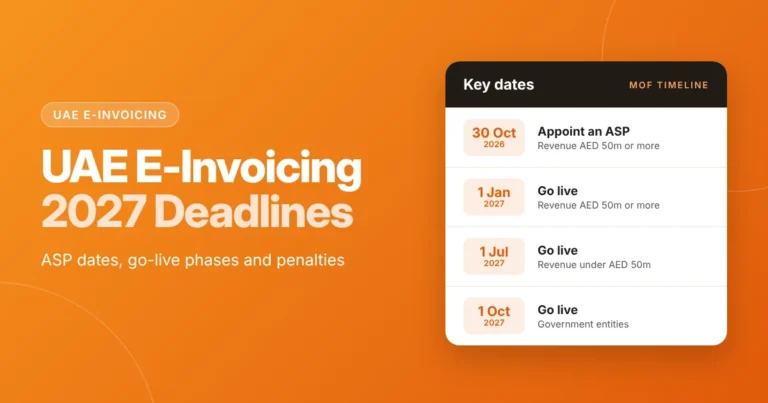
The UAE government has taken a major decision: it made e-invoicing mandatory after 1 January 2027 for businesses with annual revenue of AED 50 million or more. These businesses must appoint an Accredited Service Provider (ASP) by 30 October 2026, followed by smaller businesses by 1 July 2027.
Key Takeaway
- The UAE e-Invoicing Portal has been introduced to encourage E-invoicing.
- Businesses must appoint an ASP depending on the revenue.
- Businesses that miss the electronic invoicing deadlines have to pay AED 5,000 a month.
- UAE taxation holds excellent career opportunities.
The UAE e-Invoicing Portal
With the increasing use of electronic invoicing services, or e-invoicing, the United Arab Emirates (UAE) is making significant progress toward digital transformation and improved tax compliance. The UAE e-Invoicing Portal, which was introduced by the UAE Ministry of Finance (MoF) on October 24, 2024, offers crucial advice for companies to comprehend, get ready for, and eventually adhere to the nation’s new e-invoicing framework.
The UAE E-Invoicing course helps individuals and businesses to learn how to handle digital invoicing, maintain tax compliance, and enhance financial procedures in the UAE. The course aims to provide you with a thorough understanding of the advantages of utilizing e-invoicing solutions to expand your company. What e-invoicing is, how to adopt it, and important considerations for a successful implementation are all covered in the training. Before we discuss more about the UAE E-Invoicing course, let’s first go through the fundamentals.
What is e-invoicing?
The systemized process of creating, sending, receiving, and storing invoices in a structured digital format is known as electronic invoicing, or e-invoicing. It will substitute machine-readable data that is automatically processed for conventional paper-based or PDF-based invoices. A PDF or scanned copy, even if it is emailed, is not an e-invoice. An e-invoice is a structured data file (XML) that follows the UAE’s PINT AE format.
What is the significance of e-invoicing in UAE Business?
To ensure that invoice data is sent to the FTA in real-time or almost real-time, the system of electronic invoicing in the UAE will standardize the format of VAT tax invoices. It is a part of a larger global trend observed in numerous EU member states, Saudi Arabia, and India.
As part of its effort to improve tax compliance, encourage openness, and modernize the tax system, the Federal Tax Authority has stated that the e-invoicing system is being introduced in phases. Redefining the nature of financial transactions in the United Arab Emirates, phase 1 of the e-invoicing effort becomes mandatory on 1 January 2027 for businesses with annual revenue of AED 50 million or more.
E-Invoicing in the UAE: Key Highlights
The UAE Ministry of Finance provided more information on the timing and model’s adoption during the Dubai E-invoicing Exchange Summit.
The pilot and voluntary phase began on 1 July 2026, and mandatory adoption comes in phases:
| Who | Appoint an ASP by | Go-live date |
| Voluntary and pilot phase | Not applicable | From 1 July 2026 |
| Revenue around AED 50 million or more | 30 October 2026 | 1 January 2027 |
| Revenue less than AED 50 million | 31 March 2027 | 1 July 2027 |
| Government entities | 31 March 2027 | 1 October 2027 |
The ASP deadline for businesses with revenue of AED 50 million or more was originally 31 July 2026. The Ministry of Finance extended it to 30 October 2026, but the go-live date of 1 January 2027 did not change.
What are the penalties for not complying?
The penalties for electronic invoicing include:
- AED 5,000 every month for the delay in implementing the system or appointing an ASP.
- AED 100 for each e-invoice or e-credit note not issued and sent on time, capped at AED 5,000 a month for each.
- AED 1,000 daily if delay in reporting a system failure or changes to registered data.
Businesses taking part in the pilot phase are not charged these penalties.
E-Invoicing Framework in UAE
The Peppol “5-corner” model serves as the foundation for the UAE’s CTC e-invoicing architecture, sometimes referred to as the “DCTCE” model. There are five primary components to the “5-corner” model:
Issuer: The one who creates the invoice.
The person who gets the invoice is known as the receiver.
FTA’s E-Billing System: It allows for data interchange by integrating with the Peppol PINT AE specification. Although it serves as an invoice repository, the e-billing platform does not verify the invoices.
Sender Accredited Service Provider (ASP): Confirms the information and forwards the invoice to the recipient and the tax authority. ASP
Receiver ASP: Confirm the information received and send the electronic invoice to the buyer.
In simple terms, an Accredited Service Provider (ASP) is a company approved by the Ministry of Finance to validate e-invoices and send them to the buyer’s ASP and to the FTA. PINT AE is the UAE’s invoice data format, based on the Peppol standard.
Now that you know how the UAE’s e-invoicing system works, the next step is getting your own systems ready. Many UAE companies run SAP or another ERP, so planning the right SAP e-invoicing strategies early, such as connecting the ERP to an Accredited Service Provider and testing invoices and credit notes, makes the switch much smoother. The UAE E-Invoicing course covers the complete e-invoicing process in detail, including ERP integration and the key setup decisions, with hands-on training so students can handle real tasks with confidence.
Major Topics and Skills Covered
The curriculum covers all the topics that are important to the industry and in high demand. It primarily includes
- Introduction of e-invoicing
- Goals of e-invoicing in the UAE
- Recognizing e-invoicing’s advantages
- Core features of e-invoicing
- Creating and overseeing electronic bills
- Increasing efficiency by automating billing procedures
- Accounting software integration with electronic invoicing
- Taking care of debit and credit notes
- Managing changes and cancellations of invoices
- Producing reports for tax filing and audits
Apart from entrepreneurs and business owners, this course is suitable for all professionals in accounting and finance, tax advising, accounting, and ERP Software, and also for newly graduated individuals and job seekers. The training enables job aspirants to pursue the following career options:
- Accounting Professional
- Bookkeeper
- Finance Manager
- Tax Advisor
- Billing Expert
- Accounts Receivable/Payable Clerk
- GST Professional
- Entrepreneur
Learn the fundamentals of e-invoicing to start using them in your career right away. To guarantee compliance, boost productivity, and maintain your lead in the changing financial landscape, get professional advice from expert trainers like Owais Mirchawala to ensure your success.
Owais Mirchawala is an expert and successful tutor in all domains of ICAEW, O/A levels and ACCA in UAE with over 15 years of expertise. He has just introduced a comprehensive UAE E-Invoicing Course, including the outline of the UAE’s electronic invoicing system, its legal underpinnings, implementation schedule, and effects on enterprises. The program goes over the definition of e-invoicing, the procedures needed to deploy it, and the important considerations for a successful rollout. Contact him now to learn more about the course.
Frequently Asked Questions
How do you qualify for an e-invoice?
To qualify for the e-invoice in the UAE, businesses should meet specific needs related to VAT compliance, invoice formats, and data exchange standards.
Who issues an e-invoice?
The supplier (the seller) issues the e-invoice, and it is sent through the supplier’s Accredited Service Provider. The system presently covers B2B and B2G transactions.
Who is a recommended tutor for pursuing the UAE e-invoice course?
Owais Mirchawala is a renowned name in different finance- and accounting-related courses; he has now come up with a new pack of the UAE e-invoice course to take you through the e-invoice process.
Is e-invoicing mandatory in the UAE?
Yes, e-invoicing will become mandatory from 1 January 2027 for businesses earning an annual revenue of AED 50 million or more. Businesses earning below AED 50 million will go for e-invoicing after 1 July next year.
What are ASP and PINT AE?
An Accredited Service Provider (ASP) is a company approved by the Ministry of Finance to validate e-invoices and send them to the buyer’s ASP. PINT AE, UAE’s invoice data format, is based on the Peppol standard and sets the fields that every e-invoice must carry.