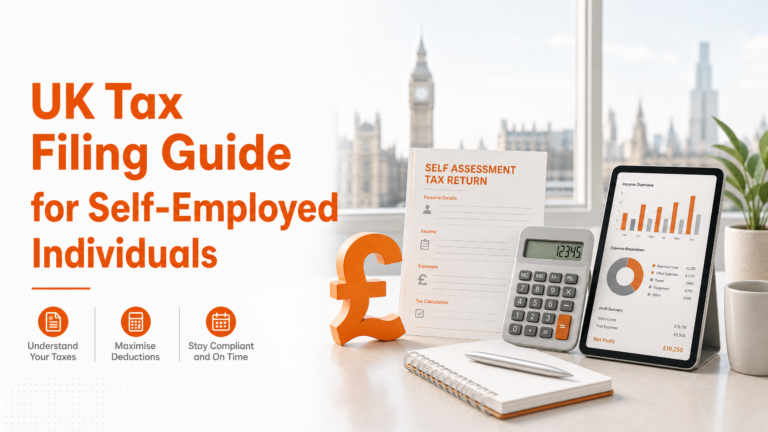
Dealing with the tax monster is mandatory, whether you are self-employed or a freelancer. Managing tax requirements on your own appears to be rather difficult, particularly for those who are not really interested in mathematics. This blog is specifically crafted as a UK tax filing guide for freelancers and sole proprietors to make it a little simpler for you.
Freelancers and self-employed people must manage the HMRC’s Self-Assessment tax system, keeping track of earnings, permitted spending, and crucial filing dates, in contrast to regular employees. Freelancers can file more precisely and steer clear of frequent errors by following this advice, which breaks down each process.
Step 1: Register as Self-Employed with HMRC
You should then register for Self Assessment, a specific method of reporting your earnings to the government, if your earnings reach £1,000 in a tax year. After the first tax year in which you received your income from self-employment ends, you have until October 5th to register. After processing your form, HMRC will provide you with a Unique Taxpayer Reference (UTR) number that identifies you in their system and let you know that they are aware of your self-employment.
Step 2: Complete Your Financial Documentation
Make sure you have all of your prior year’s financial records. If you work part-time as a freelancer, this includes earnings from your primary employment. Self-employed people are required by HMRC to keep track of all their earnings and company expenses through bank statements, invoices, and receipts.
Step 3: Check Your Deductibles and Expenses
Checking all of your business expenses and determining which ones are deductible, that is, able to be deducted from your taxable profit, is essential before figuring out how much self-employed tax you owe.
What costs am I allowed to list?
Any expenses incurred “wholly and exclusively” for your self-employed work may be claimed by HMRC, including:
- Laptops
- Design software
- Office supplies
- Travel costs for client meetings
- Advertising
- Training
- Insurance
- Professional subscriptions3
Step 4: Know Your Taxable Profit
You can determine your taxable profit once you’ve checked your spending and found what you can claim. This is your entire income from self-employment less all permitted business expenses. The outcome establishes your annual income tax and national insurance obligations.
Step 5: Do Your Self-Assessment Tax Return
You can disclose your taxable income to HMRC via the Self Assessment tax return.
You will want a ten-digit Unique Taxpayer Reference (UTR) in addition to the documents listed above. While paying taxes may seem like an administrative chore to some, it’s actually a chance to prevent financial difficulties and possibly save money when other types of employment can’t.
Step 6: Make the Tax Payment
HMRC will verify the amount of income tax and national insurance you owe when you submit your tax return. Generally, payments are made twice a year: the primary payment deadline is January 31st, and the second “payment on account” date is July 31st.
These payments help stretch out the cost of your taxes for the following year so you don’t have to pay a big bill all at once. To avoid overpaying, you can request that HMRC lower your account contributions if your income declines or your situation changes. You can protect your cash flow by properly managing this process, particularly if your revenue varies throughout the year.
Learn tax filing with the top-notch UK taxation course at Mirchawala and lead a successful career ahead!
Frequently Asked Questions
Q: Are freelancers and self-employed people eligible for any further tax breaks?
Ans: The Annual Investment Allowance (AIA) allows you to deduct the entire cost of most important company equipment up to £1 million7, in addition to the trading allowance, which allows you to claim up to £1k in tax-free revenue.
Q: As a freelancer, who must file a tax return?
Ans: A self-assessment tax return is required if you:
- Make more than £1,000 a year as a freelancer or sole proprietor.
- Become a self-employed person or a sole proprietor.
- Possess additional income (such as rental income or investments) that is not subject to PAYE taxation.
Q: What are the significant dates for UK tax return filing?
Ans: In the UK, the tax year begins on April 6 and ends on April 5 of the subsequent year. For online self-assessment submissions, it is 31st January, and if you’re filing a paper tax return, the deadline is 31 October.