The demand for finance experts is continuously increasing in Japan. This is particularly true for those who can operate to international standards due to Japan’s sizable and expanding community of multinational organizations, including both Japanese corporations with worldwide reach and foreign companies with Japanese operations.
ACCA is one of the top certifications for finance and accounting professionals. In this blog, we will discuss ACCA Eligibility in Japan and what it requires to pursue ACCA in Japan.
ACCA Eligibility in Japan after 12th
Finishing the higher secondary or Class 12 (10+2) is the entry stage for pursuing ACCA in Japan. You can register directly for the complete ACCA qualification without using the FIA pathway if you passed your higher secondary exam.
Take the first step toward ACCA, enrol with expert guidance today
 Enrol in ACCA Today
Qualifications for Direct Entry
ACCA Global establishes precise academic standards for direct admission into the full ACCA qualification at the Class 12 level, instead of just a “pass.”
Five subjects: Qualify in 5 subjects at the 10+2 level, taken in one academic year.
English and mathematics (or accounting) are two of the five required subjects.
Required percentage: At least 65% in two of those five areas and more than 50% in the other subjects.
Stream: Science and arts students who meet the subject and percentage requirements are equally eligible for admission to ACCA in Japan, although commerce students have a natural advantage due to their familiarity with accounting concepts.
Candidates whose percentages are below the cut-offs, who don’t have English or math in their five disciplines, or who don’t meet any of these standards
They need to enroll through the Foundations in Accountancy (FIA) route. The FIA method is considered an alternate entry channel and does not have these % restrictions.
ACCA Eligibility After Graduation: Exemptions for Entry
Aspirants need to complete 13 papers in total to be eligible for ACCA in Japan, although depending on their level of academic qualification, they may be eligible for different exemptions.
Graduates can claim exemptions from many papers depending on their previous qualifications; graduates from accredited universities have the best access to ACCA. This cuts the total completion time and lowers the number of examinations needed.
Qualifications for Graduates:
B.Com graduates: Eligible for direct entry with potential exemptions from 3–5 Applied Knowledge and Applied Skills papers, depending on the university and courses studied.
Graduates of BBA and BMS programs are eligible for direct admission with one to three exceptions, usually in Management Accounting (MA) and Business and Technology (BT).
MBA Finance graduates: Eligible for 2–4 exemptions, covering core accounting and management papers.
CA Intermediate (both groups): Eligible with up to 5 exemptions from Applied Knowledge and Applied Skills papers.
Fully qualified CA (ICAI): Get exemptions in nine papers, and they need to appear for only the four Strategic Professional papers and the Ethics module.
M.Com and other postgraduates: Exemptions vary based on institution and syllabus, generally 3–5 papers. The exact amount of exemptions varies by your unique university, the course covered, and ACCA’s accreditation agreements. The ACCA Exemptions Calculator allows you to verify your exemptions.
Guiding Your First Step Toward ACCA, With Free Expert Support
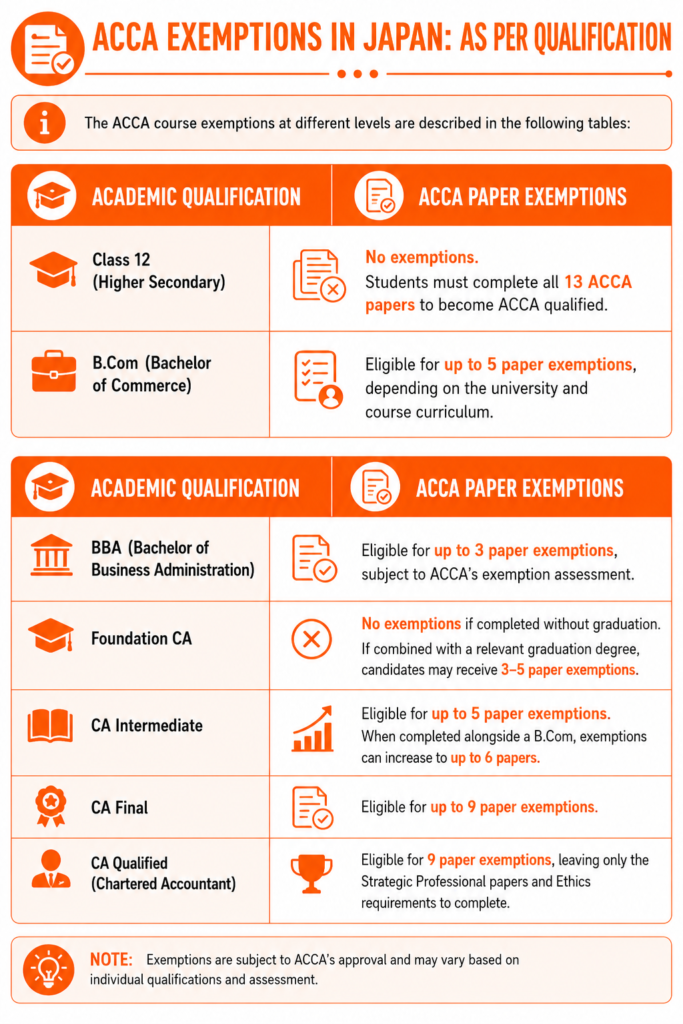
ACCA Exemptions in Japan: As per Qualification
The ACCA course exemptions at different levels are described in the following tables:
Age Limit for ACCA Qualification
This is one of the most often asked questions. The response is simple and uplifting.
There is no higher age limit for ACCA registration. If you complete the educational eligibility requirements, you can register for ACCA regardless of your age—18, 35, or 50.
Do you want to join the ACCA?
Hopefully, you are now clear on the rules for ACCA eligibility in Japan. To help you succeed on ACCA exams and grow your financial career, Mirchawala offers professional coaching with top ACCA tutors, individualized guidance, and adaptable study schedules.
Frequently Asked Questions
Does Japan recognize ACCA?
Yes, multinational corporations, international audit firms, and financial services organizations that operate in Tokyo and throughout Japan recognize ACCA and actively hire ACCA-qualified professionals.
Is there any eligibility criteria for the ACCA?
The ACCA course in Japan is open to students who are pursuing a degree in commerce (BCOM, BBA, BMS, etc.) or who have completed their B.A. or B.SC. at an accredited university (no mark limits).
How to join the ACCA career path?
The first step to a prosperous career in accounting and finance is learning how to join the ACCA. Before moving on to full membership, you can try to become an ACCA affiliate after passing the necessary tests and gaining real-world experience.
You may successfully follow this path and unlock worldwide opportunities if you are committed and have the necessary resources.
Is there an age limit for ACCA eligibility in Japan?
There is no maximum age limit.