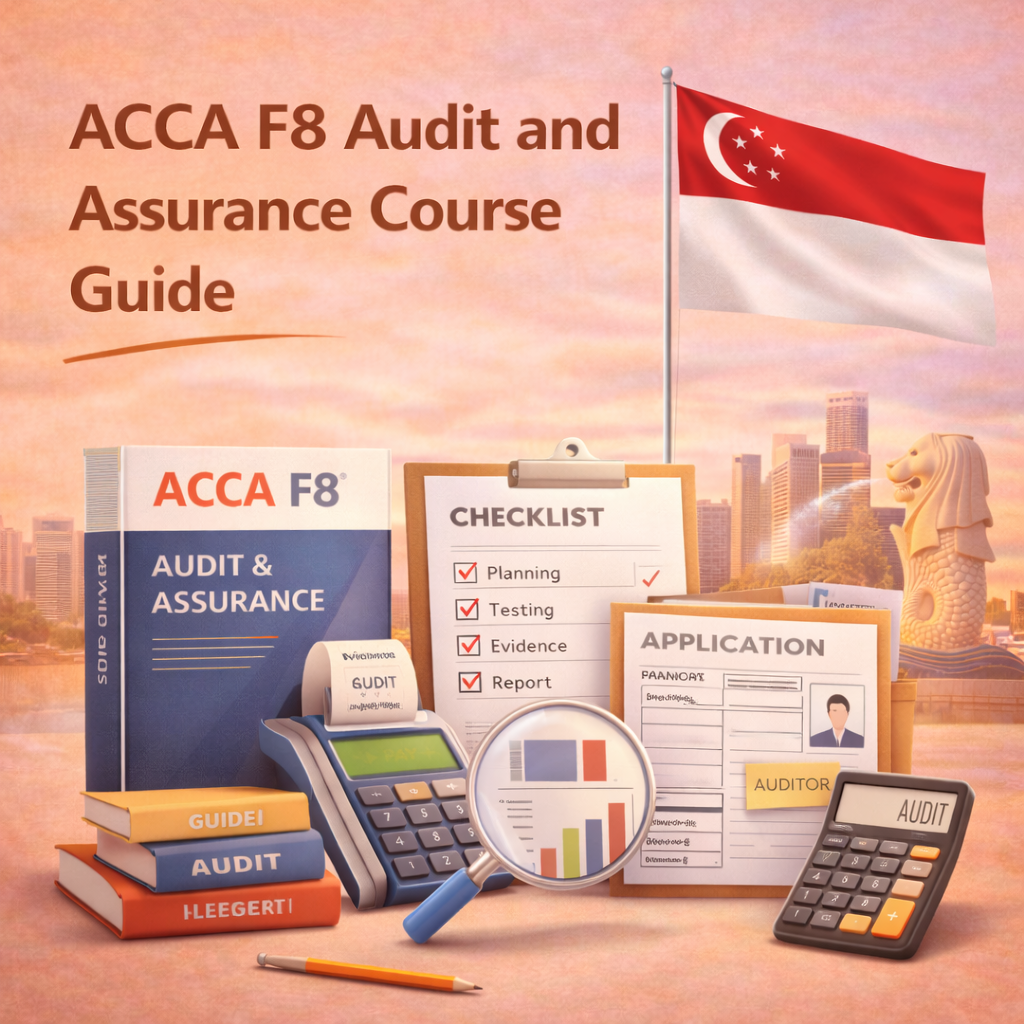
Qualifying ACCA F8 Audit and Assurance in Singapore is a challenging but worthwhile part of the ACCA learning journey. This exam assesses your understanding of auditing concepts, methods, and their practical applications.
This exam’s structure pushes students to grasp a variety of technical ideas and topics, providing a chance to gain thorough knowledge. In this article, we will first understand the ACCA audit and assurance syllabus, key topics covered, and helpful tips to pass the ACCA F8 exam.
Acquiring a solid understanding of auditing is crucial for anyone wishing to join the ACCA. It helps you acquire the necessary expertise for the international accounting sector. So, keep scrolling to learn different aspects and master them.
ACCA F8 Audit and Assurance Syllabus
All facets of the audit process are covered in five major sections of the ACCA AA course. The parts guarantee that students understand how an auditor organizes and carries out an audit in a professional environment.
Section A: Audit Framework and Regulation
Assurance and External Audit Concept
Corporate Governance and Professional Ethics (ACCA Code of Conduct)
Section B: Planning and Risk Assessment
Assessing Audit Risk vs. Business Risk
Understanding the Entity and Its Environment
Section C: Internal Control Systems
Evaluating Internal Controls and Identifying Deficiencies
Tests of Control and Communication to Management
Section D: Audit Evidence and Procedures
Financial Statement Assertions: to Audit Testing
Substantive Procedures for Specific Financial Items
Automated Tools and Techniques (Data Analytics in Audit)
Section E: Review and Reporting
Subsequent Events and Going Concern Reviews
Types of Audit Opinions and the Independent Auditor’s Report
Eligibility for ACCA F8 paper
Prerequisite Papers before doing ACCA F8 in Singapore
- Complete Applied Knowledge Level
- Complete the preceding Applied Skills Level papers
- Educational Requirements:
- 10+2 education with Mathematics and English or a bachelor’s degree in a related field
Audit and Assurance Exam Structure
ACCA F8 in Singapore includes two primary sections—written and multiple-choice questions.
Part A includes 30 questions of the objective type. Each question is worth two marks.
These questions assess your understanding of the fundamentals and cover a wide range of topics from the audit and assurance course.
Part B: comprises three scenario-based questions, each worth 10 points.
These questions assess the candidate’s ability to apply theoretical ideas to real-world auditing scenarios and call for detailed written responses.

today!
Significant Topics Included:
Planning, carrying out, and reporting the audit process.
Internal Controls: Design and evaluation.
Ethical Principles: Using ACCA’s ethical standards in auditing situations.
Qualifying Tips for ACCA F8 in Singapore
- To cover such a vast ACCA audit and assurance syllabus, start your preparation well in advance.
- Increase your focus on subjects including audit reports, internal controls, and audit risk.
- Do regular practice to ensure that time wastage is less than or equal to the actual scenario exam, solve past exams, and set the timer.
- Use flashcards or summary notes for ACCA exam preparation; these can be revised wisely.
- For any changes to the syllabus or format of the exam, keep monitoring the ACCA Global’s website.
Bottom Line
Overall, a student can effectively pass the ACCA AA exam by studying the course content with regular practice and having a solid grasp of the syllabus. Join Mirchawala’s to get professional guidance and support to excel and grow with ACCA F8 in Singapore.
Frequently Asked Questions
What is ACCA F8?
The Audit and Assurance (AA) paper helps you gain knowledge and comprehension of the assurance engagement process and its application within the professional regulatory environment.
What is the audit and assurance syllabus?
There are basically six sections in the Audit and Assurance course. In addition to introducing governance and professional ethics related to audit and assurance, the syllabus begins with the nature, purpose, and scope of assurance engagements, including the statutory audit and its regulatory framework.
Is the ACCA F8 difficult?
Compared to previous ACCA papers, the ACCA Audit and Assurance has had a lower pass rate. The reason might be the broad syllabus: covering a wide range of topics, including both theoretical and practical viewpoints. With the right approach, ACCA audit and assurance past papers and guidance, you can succeed in this paper.