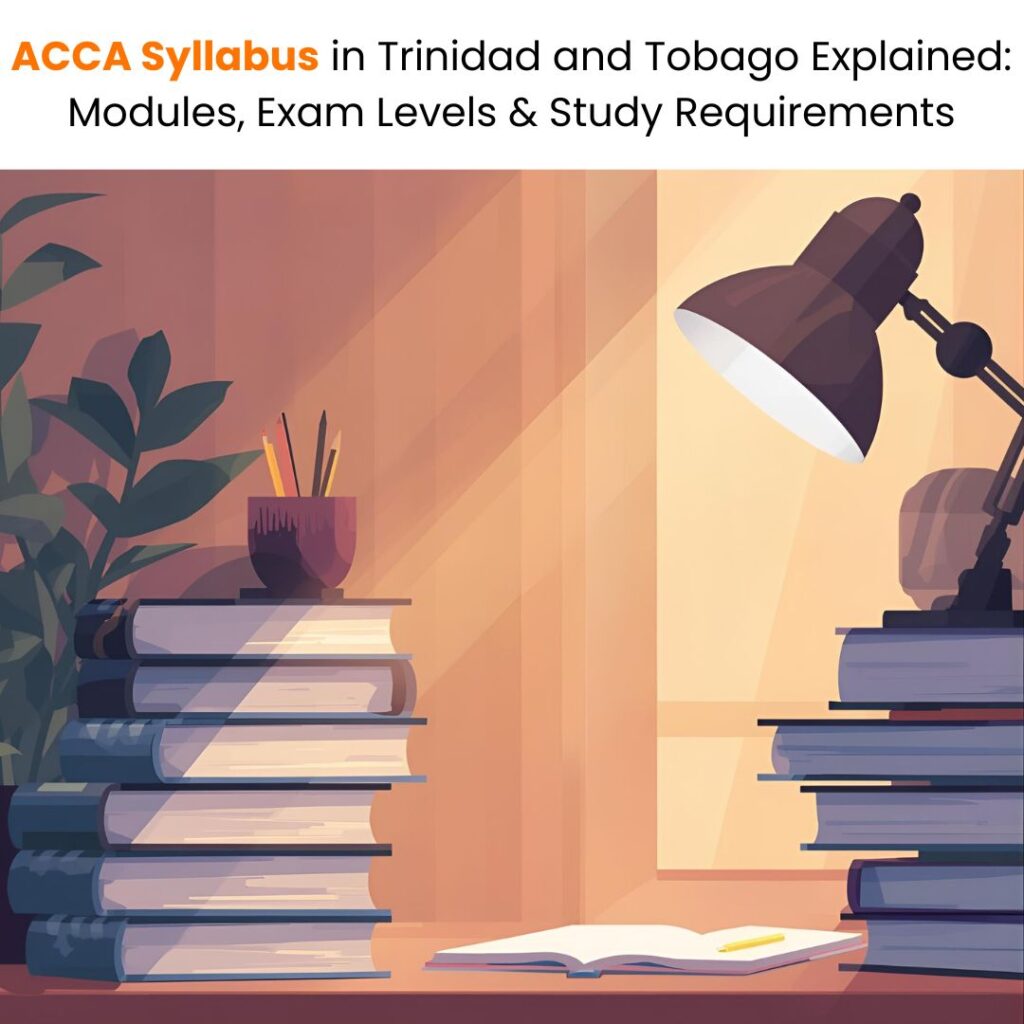
Being a resident of Trinidad and Tobago, if you want to develop a stable career in accounting, it is most likely that someone has already told you that joining ACCA is a great way to climb the success ladder. It is common that students are eager to begin with ACCA, but at the same time a little apprehensive, as the entire journey seems quite lengthy. If that is how you feel too, don’t worry; learning more about how ACCA Syllabus in Trinidad and Tobago is structured in Trinidad and Tobago can make your entire learning journey a lot less daunting.
The ACCA is recognized throughout the Caribbean because it is a passport to employment in auditing, finance, taxes, consulting, and executive management. It is considered the hallmark of sound technical competence, professional conduct, and discipline by employers everywhere. If you are aware of how the syllabus is structured, you can prepare for the exams with confidence and know what to anticipate at every step.
This is a step-by-step guide of the ACCA syllabus, exam structure, modules, level structure, and studying requirements for Trinidad. By the end of this, you will be able to navigate from the first paper to the last professional exam.
Understanding the ACCA Structure
The ACCA exam in Trinidad is similar to the worldwide structure, which comprises three distinct stages. It helps develop your skills gradually, thereby transforming you from a beginner who acquires fundamental knowledge to a sophisticated professional with high-level judgment.
The three levels are:
- Applied Knowledge
- Applied Skills
- Strategic Professional
The levels consist of a total of thirteen papers. With the revised ACCA Course Outline 2025, the syllabus remains as it is, with a strong emphasis on a learning approach that is relevant to a workplace setting, hence meeting the requirements demanded by employers in Trinidad and Tobago.
Applied Knowledge Level
The Applied Knowledge level is the level from which you begin your journey. The papers that fall within this category are used to make readers aware of the basic principles used in accounting and finance.
The three research papers that you are required to read at this level are:
- Financial Accounting (FA)
- Management Accounting (MA)
- Business and Technology (BT)
This set of papers is aimed at giving you a foundation in accounting, financial statements, cost management, and the business environment. It is common for most students in Trinidad to find this manageable because the content is easy to comprehend, even when one has a tight schedule. Computer-based CATS are offered on demand throughout the year.
Applied Skills Level
After the completion of Applied Knowledge, you proceed to Applied Skills, which is regarded as the heart of the ACCA syllabus in Trinidad and Tobago. Here, your journey begins to discover more in-depth areas, which are even more workplace-related.
This category consists of six papers:
- Corporate and Business Law (LW)
- Performance Management (PM)
- Taxation (TX
- Financial Reporting (FR)
- Audit & Assurance (AA)
- -Financial Management (FM),
Such homework assignments assist in developing your analytical skills, which are essential in accounting. For instance, PM helps you feel at ease when preparing the budget and evaluation, FR helps you learn how to prepare financial statements, while TX is concerned with teaching taxation principles.This level has session-based exams, which occur four times a year. In this case, the subjects are broader, hence the need for more structured study plans, because the style of the exam also shifts towards becoming more analytical. The revised ACCA Course Outline 2025 further enhances digital skills at this level, making students more industry-ready.
Strategic Professional Level
The final level is Strategic Professional, which equips you with the mindset of a senior accountant or financial leader. This level consists of two compulsory papers and two optional papers.
Compulsory papers
- Strategic Business Leader (SBL)
- Strategic Business Reporting (SBR)
- Optional papers (choose two):
- Advanced Financial Management (AFM)
- Advanced Audit & Assurance (AAA)
- Advanced Performance Management (APM)
- Advanced Taxation (ATX)
This is where you apply everything that you have learned in the previous levels of SBL. SBL enhances your skills in leadership, communication, and strategic decision-making skills. SBR trains you on how to cope with difficult reporting requirements and professional judgments. The optional subjects that you choose enable you to focus on a sector that interests you, which may be audit, analysis of performance, taxation, or financial strategy.
ACCA Papers structure in Trinidad & Tobago
You can now sit for your ACCA papers online via ACCA Global, with a choice of learning providers available in the country. The Strategic Professional exams, as well as Applied Skills, are offered four times a year.
The flexibility offered is a massive plus when it comes to working professionals. You can plan your learning pace as per your convenience, whether you want to complete the courses quickly or take your time to finish every module.
Requirements For ACCA In Trinidad & Tobago
In order to pursue the full ACCA qualification, a minimum of three O-Level subjects, including English and Mathematics, is required. Others who do not have the minimum requirement can pursue a ‘Foundations in Accountancy’ path, which leads to ACCA.
Once registered, please find the following details:
- Regular studying habits per week
- Access to a reliable internet connection for online learning resources
- Structured learning path for different levels
- Support from an Approved Learning Provider
- Practice Tests & Revision Packages
In Trinidad, most students have to balance ACCA studying with employment or family life. This means that a plan is necessary, although it is intended to be flexible enough to fit in with different lifestyles.
The Selection of a Suitable Learning Provider in Trinidad
Picking a reliable learning source might make your preparation easier. Find learning sources that provide:
- Experienced tutors who are familiar with the ACCA syllabus in Trinidad and Tobago
- Flexible class schedules
- New learning resources to match the ACCA course structure for 2025
- Mocks Exams & Revision Lessons
- Student mentorship & advising
- Good pass rates
In-class instruction is best for some students who want to concentrate. Others prefer online instruction because of its convenience. Choose what is best for your style.
Effective Tips for Every ACCA Student
- Effective tips for every acca student
- Plan sitting in the exam in advance, such that you know which paper to take.
- Make use of official resources from acca to keep yourself updated with the acca syllabus.
- Give maximum participation in study groups with students in Trinidad and Tobago.
- Focus on the concept clarity over memorization.
- Give some extra time for more difficult topics, such as PM, FR, and SBR
Conclusion
Stepping on the ACCA journey can be a daunting process, particularly when you are balancing a career, education, and other aspects of your life in Trinidad and Tobago. However, once you are aware of the ACCA exam structure available in Trinidad, the modules, and how the different levels interconnect within the larger scheme, things become a lot clearer. Each level of the ACCA syllabus in Trinidad and Tobago provides you with skills that are valuable within a real-world setting, putting you one step closer to becoming a confiden,t qualified accounting professional.
Frequently asked questions
Is acca worth studying in Trinidad and Tobago?
Yes, ACCA has a great value in Trinidad and Tobago and across he caribbean region. Employers in accounting firms, banks, multinational companies, and government organizations recognize acca as a strong professional qualification.
How much time is needed to complete the acca qualification in Trinidad and Tobago?
The time that can be taken to acquire acca certification varies according to education and exemptions and cannot be the same for all individuals. An average of three to four years is taken by students to finish all acca exams while studying part-time.