INTRODUCTION:
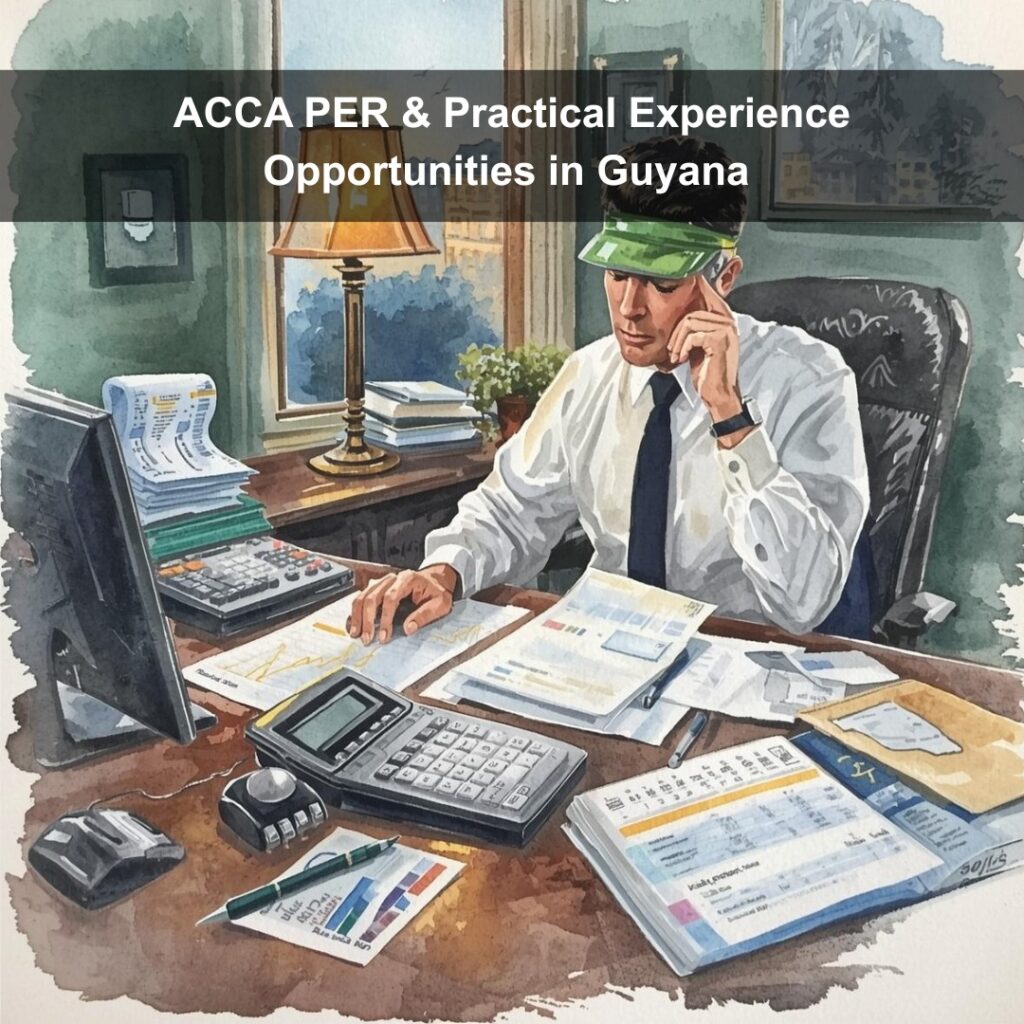
Alongside multiple ACCA requirements, the PER (Practical Experience Requirement) remains a mandatory one that students usually fail to complete efficiently without proper guidance. Aspirants usually confuse the crucial steps to complete this academic requirement; hence, for their assistance, we have tailored this value-adding guide about ACCA PER in Guyana. Through this descriptive guidebook, you can explore all the important considerations and ACCA PER opportunities in Guyana to plan your steps accordingly.
The qualification of ACCA in Guyana is based on multiple essential academic requirements; each of the requirements examines your skills, expertise, and knowledge to prepare you for the practical financial world. To be precise, ACCA PER in Guyana is considered to be amongst the most crucial academic obligations as it offers a value-adding exposure to the professional world, which should be taken as a chance to grow professionally. To understand more about ACCA PER in Guyana and available opportunities in the region, continue reading the blog till the end.
WHAT ACCA PER IN GUYANA?
ACCA Practical Experience Requirement Guyana, also known as the PER, is an essential academic requirement of the qualification; without completing the PER, one can not become a fully-qualified accountant. Therefore, it can not be overlooked at any cost that students should plan their PER efficiently if they want to become a qualified ACCA member without any hurdles. ACCA Practical Experience in Guyana demands that aspirants complete 36 months of relevant work experience with an approved employer and get it documented as well as signed by a senior ACCA member, preferably. Mind that the professional role should be related to the ACCA qualification and should be well-recorded and signed by a credible source.
WHAT COUNTS AS RELEVANT EXPERIENCE?
The following experiences are considered relevant to the ACCA PER in Guyana. Aspirants are encouraged to explore them and see if they are eligible for them.
- The experience/professional role must include finance or accounting tasks, practices, or work responsibilities.
- Paid jobs, internships, part-time/full-time roles, or even voluntary work can also be counted as experience if they are related to the qualification.
- Supervision and documentation/recording of the experience are very important and should not be compromised; students can also use My Experience via ACCA Global’s website for better assistance and management.
WHEN TO START ACCA PER IN GUYANA?
The perfect time to begin completing your ACCA PER in Guyana is to do it alongside your ACCA exams; many ACCA-approved employers in Guyana support students in completing this academic requirement by offering entry-level jobs. Once students have completed the Applied Knowledge level, they are advised to search for the relevant jobs; by completing both academic requirements, students are not only able to complete the qualification earlier but also get an enhanced understanding of the complex topics by integrating theoretical knowledge into practical scenarios.
WHAT HAPPENS AFTER COMPLETING ACCA PER IN GUYANA?
ACCA Practical Experience Requirement Guyana is said to be so crucial because of the fact that the ACCA qualification can not be completed without it. After a student has completed the PER and got it recorded under accredited supervision, it is supposed to be submitted to the ACCA Global alongside the membership application. Responsible authorities verify your experience to ensure no fraudulent activities are involved; once the application and experience are approved, an individual becomes an ACCA member (fully-qualified). This title is not ordinary; rather, it brings forward numerous value-adding opportunities to strengthen your standing in the practical world.
ACCA PER OPPORTUNITIES IN GUYANA:
As mentioned before, several ACCA-approved employers in Guyana offer entry-level job positions for students trying to complete their PER requirement; these employers are recognized by the ACCA body and hence are much more credible. The approved employers can be from diverse backgrounds, sectors, and industries; students are advised to look for such roles in different industries and choose a role that aligns with their career goals so that the experience cannot only complete their academic obligation but also make their career goals achievable. Here are certain job opportunities/positions commonly offered in Guyana that ACCA students can take over and complete their ACCA PER in Guyana successfully.
- Accounting/Finance Internships
- Assistant Accountant/ Accounts Clerk
- Finance Assistant
- Trainee Accountant
- Tax Assistant
- Accounts receivable/ payable clerk, etc.
These were some of the common positions that students can consider securing to complete the PER requirement and become a fully-qualified professional; note that all these roles are progressive and can lead you to your desired career goals.
CONCLUSION:
ACCA PER in Guyana is indeed a vital academic obligation that can not be overlooked at any cost; only after completing this requirement can an individual become a fully-qualified ACCA professional. To complete the ACCA Practical Experience in Guyana, aspirants have to gain 36 months of relevant work experience, preferably with an approved employer and under the supervision of a credible ACCA member; the experience should be well-recorded and submitted to the ACCA Global for verification. Once an aspirant gets their experience verified, they can soon acquire the status of ACCA member, a status that opens the door to numerous success-driven opportunities.
FREQUENTLY ASKED QUESTIONS:
Q1: Enlist some of the ACCA-approved employers in Guyana.
Answer: Some of the top ACCA-approved employers in Guyana include Grant Thornton, Deloitte, KPMG, PwC, etc. Students are advised to research local employers as well and make their decision wisely.
Q2: How does PER help the ACCA career in Guyana?
Answer: The ACCA PER is quite helpful in offering you a progressive accounting career in Guyana. It gives aspirants an exposure to the practical financial world, and the experience could help students secure leading positions once they become fully qualified professionals. Therefore, students should not take it only as an academic requirement but also as a building block for their career.