“THE SHIFT FROM LEARNING THEORY TO THINKING LIKE A PROFESSIONAL”
ACCA is a comprehensive accounting credential that typically overwhelms students with its comprehensiveness and academic uniqueness; the academic path remains popular for its complexity. But those who know a bit more about this qualification agree that the real academic challenges lie in the strategic professional level; while other academic levels can be unique, the strategic professional exams are straight-up challenging.
Many students struggle to crack the strategic professional exams and seek some effective solutions to this problem, but before coming up with any way out, it is better to look for the root cause of this academic struggle. Are you also looking for the reasons why the aspirants typically struggle with strategic Professional modules? Here is an in-depth virtual guide that will help students understand the factors influencing the academic complexity so that they can avoid the common acts that can lead them to academic uncertainty; read till the end to get all the answers.
ABOUT THE STRATEGIC PROFESSIONAL LEVEL
The Strategic Professional level is the advanced academic part of this qualification; this is the last level that consists of four papers, out of which two are compulsory, while the other two are optional. The compulsory Strategic Professional exams are Strategic Business Reporting (SBR) and Strategic Business Leadership (SBL); while the optional exams are Advanced Taxation (ATX), Advanced Financial Management (AFM), Advanced Performance Management (APM), and Advanced Audit & Assurance (AAA). Note that from the optional papers, aspirants have to choose any two that best align with their academic interests, goals, and strengths.
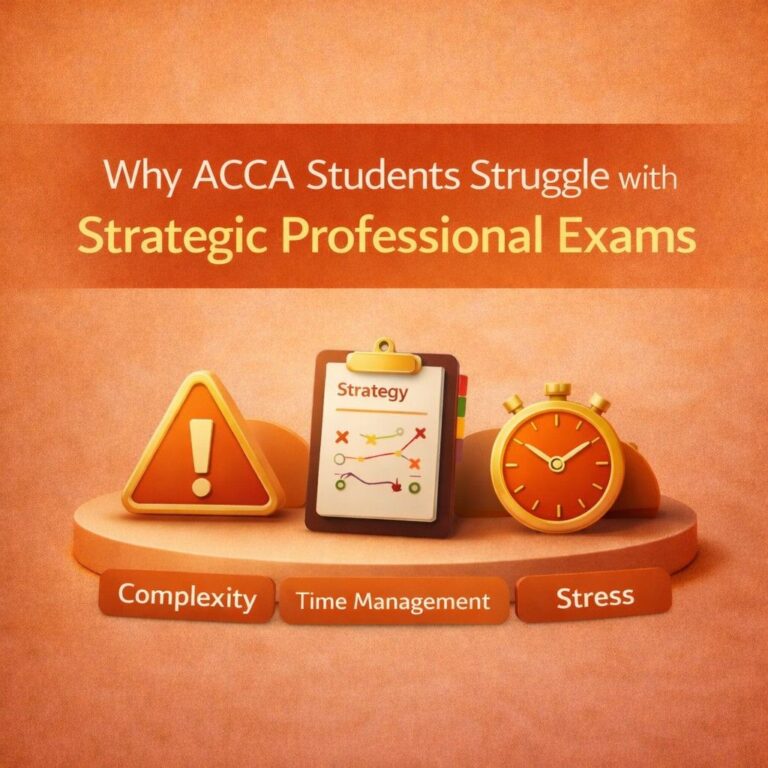
WHY STUDENTS STRUGGLE WITH STRATEGIC PROFESSIONAL EXAMS?
It is widely observed that ACCA students find exams in this advanced level very complicated; hence, they struggle to pass them. There are several reasons that students gave for this academic struggle; some of the common factors that hinder their performance in these exams are discussed below:
1: A SHIFT FROM MEMORISATION TO PROFESSIONAL JUDGEMENT
Unlike usual exams that require students to memorise rules, practice standard questions, or apply learning formats, these exams don’t follow a similar approach; rather, in this level, reality-based questions and case studies are used to examine decision-making, judgement, and professional reasoning. Basically, these exams value analytical skills more than cramming, which is why students are so overwhelmed and confused with this change.
2: WEAK EXAM TECHNIQUE
Strategic Professional exams value structured answers covering all the essential factors of the question, and unfortunately, aspirants fail to offer well-structured answers because of weak exam techniques. Aspirants are typically used to writing long theoretical answers, whereas the question demands an Applied answer; other than that, poor time management also plays a role in bad academic performance. Hence, it is one of the common reasons why students find these exams so complicated and challenging.
3: WEAK WRITING AND COMMUNICATION SKILLS
ACCA aspirants who have weak communication or writing skills often struggle to write a good, well-analyzed answer; these exams require clear structure, professional language, concise explanation, and logical flow in the answer. Anyone who can not meet these requirements typically struggles to crack strategic professional exams; therefore, students should work on these factors before appearing in such advanced exams.
4: POOR STUDY APPROACH
As this exam format with large case studies is new to students, they are overwhelmed and lack the acknowledgment of effective study approaches. Instead of focusing on applying theory to real-world situations and consistent practice, aspirants usually follow the traditional approach and fail the strategic professional exams.
5: COMPREHENSIVE CURRICULUM
The syllabus for these advanced modules is quite comprehensive, which scares the ACCA students and could be one of the reasons why they struggle with strategic professional exams.
CONCLUSION
Indeed, the ACCA strategic professional exams are a lot different than the traditional papers; hence, the approach used should be unique too. Students should alter their learning techniques in alignment with the exam demands to produce desired academic outcomes. All the reasons why students struggle to crack these professional exams are discussed in the blog; aspirants are encouraged to explore them and avoid such practices to have a good learning experience.
FREQUENTLY ASKED QUESTIONS
Q1: When should I take strategic professional ACCA papers?
Answer: These exams should be taken after passing the Applied Knowledge and Applied Skills modules as well as after completing the EPSM modules; this is the final academic part of the credential.
Q2: Should I take tuitions for strategic professional exam preparation?
Answer: Yes, students are advised to seek strong academic support and credible guidance for these complex exams; an accredited tuition provider like Mirchawala’s Hub of Accountancy can guide them throughout their learning period.
Q3: Is Strategic Professional harder than the previous ACCA levels?
Answer: Yes, comparatively, the strategic professional level and its exams are more challenging than the previous academic levels; therefore, aspirants must focus more on these papers.