“COULD YOU BE ELIGIBLE FOR ACCA EXEMPTIONS IN SRI LANKA?”
ACCA exemptions are highly valued and sought by all students as they expedite the academic journey by eliminating certain exams. This facility comes with certain conditions; to acquire ACCA exam exemptions, students must have a strong educational background. Exemptions are only granted to those students who have a prior degree in finance, accounting, or business-related fields from a reputable and well-recognized online ACCA institute. Other than that, the number of exemptions offered to each student varies depending on their academic history (such as the degree they hold and the institute they were associated with). Therefore, students who want to know if they are eligible for the exemptions and, if yes, then how many, must check it with the help of the ACCA exemption calculator available on the website of ACCA Global.
The majority of the students want to fasten up their academic journey with the ACCA course in Srilanka but don’t have much knowledge about the exemption process. Hence, to ease the procedure for you all, we have brought up this well-compiled virtual guidebook discussing all the relevant information that you must know.
What Are ACCA Exemptions?
ACCA exam exemptions allow eligible students to exclude certain exams from the ACCA curriculum, especially from the Applied Skills and Applied Knowledge levels; this fast-tracks their academic journey. The exam exemptions are only granted to those students who have a very strong academic background (an advanced qualification, a degree, or recognized professional certifications); these certifications or qualifications are supposed to be from finance, accounting, or business fields. Students can get from one to nine exam exemptions depending on the relevance of their prior degree to the ACCA curriculum.
WHO USUALLY GETS ACCA EXEMPTIONS?
ACCA exam exemptions are commonly granted to degree holders, professional qualification holders, master’s degree holders, and diploma/certificate holders. Want to know which qualifications exactly get to avail exemptions? Here is a breakdown with examples of each of the above-mentioned degrees, certifications, or qualification holders.
| DEGREE HOLDERS | PROFESSIONAL QUALIFICATIONS | MASTER’S DEGREE HOLDERS | DIPLOMS/CERTIFICATIONS |
| BBA | CA/CPA | Master’s in Accounting | Higher National Diplomas (HND) |
| Bachelor’s in Finance | ICAEW/CIMA | MSc in Accounting | Advanced Diplomas |
| Bachelor’s in Accounting | CFA | MBA | |
| Bachelor’s in Economics | AAT/FIA/CAT |
POSSIBLE EXEMPTIONS FOR EACH QUALIFICATION
Below are the qualifications that make you eligible for ACCA exemptions in Sri Lanka and the possible number of modules it can help you exempt; however, the number of modules is estimated, as it can highly differ depending upon various other aspects, such as the institute you gained your prior qualification from, etc.
| QUALIFICATIONS/CERTIFICATIONS | EXPECTED ACCA EXAM EXEMPTIONS |
| CA/CPA | With these qualifications, aspirants can expect up to 9 exemptions from the Applied Knowledge and Applied Skills levels. |
| AAT/CAT/FIA | Either of these certifications can help you exempt modules from the foundational and applied knowledge levels. |
| BBA | If it is a BBA (Hons), you can expect up to 4 exemptions, whereas if you have done this degree with a major in accounting or finance, you can get up to 7 exemptions across different academic levels. |
| MBA | A normal MBA can allow you up to 6 exemptions depending on your institute, whereas an accounting, audit, or finance-focused MBA degree can get you up to 9 ACCA exam exemptions. |
| ICAEW/CIMA | These advanced certifications can get you full ACCA exam exemptions, which include up to 9 papers. |
ACCA Exam Exemption List According to the ACCA Levels
Know that modules only from the applied knowledge and applied skills level can be exempted, which means none of the modules from the strategic professional level can be excluded. Now, let’s see in detail which ACCA modules are more likely to be exempted from each level.
1: Applied Knowledge
The basic ACCA academic level covers fundamental topics, accounting concepts, and principles; from this level, all three modules are likely to be exempted.
- Business & Technology
- Financial Accounting
- Management Accounting
2: Applied Skills
The intermediary level has six modules; all of them can be exempted in some cases. However, commonly, some of them are excluded depending on each student’s academic history.
- Financial Management
- Performance Management
- Business & Corporate Law
- Taxation
- Audit & Assurance
- Financial Reporting
Some students can avail a full exemption from all of these nine papers, while others can get a different number of papers excluded depending on their proficiency and educational background.
Criteria for ACCA Exemptions
To avail exam exemptions from the online ACCA course in Sri Lanka, students are required to meet a certain eligibility criterion, as mentioned below:
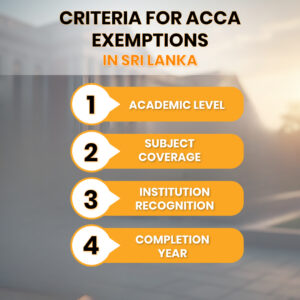
1: Academic Level
The academic level of your prior qualification influences the number of allowed exemptions; for example, aspirants with a bachelor’s degree get fewer exemptions, whereas a student with a master’s degree may get more.
2: Subject Coverage
Only those degrees are accepted that align with the curriculum of the ACCA qualification in Sri Lanka, such as accounting, finance, or business-related credentials.
3: Institution Recognition
The student who got their degree from the institute must be well-recognized by ACCA and credible; only then are students eligible to get exam exemptions.
4: Completion Year
In some cases, old traditional degrees are no longer granted exemptions because of the changes in the curriculum/academic syllabus.
How to Check Your Exemptions
ACCA aspirants can check the number of excluded exams in several different ways; however, the most common and effective tool is the ACCA exemption calculator available at the website of ACCA Global. You can explore all the other ways below.
- The most commonly used and efficient way to check the number of exemptions granted is through the ACCA exemption calculator; all you need to do is fill in the required information (name of qualification and the educational institute), and it will calculate the number of exempted modules for you.
- Students can also email ACCA if they cannot find their qualification and institute on the list and just want to be sure.
- If you still feel lost or confused regarding this exemption process, you can also seek guidance from your approved learning provider.
How to Step by Step Apply for ACCA Exemptions
Below are the steps that students can follow to apply for ACCA exemptions in Sri Lanka:
- Become an official student by registering with ACCA.
- Go to the MyACCA portal and then select the ‘Exemptions’ folder.
- Upload the scanned picture of your documents, which include a degree/certificate, transcript, etc.
- Pay the exemption fee for each paper excluded from the curriculum.
- Patiently wait for an exemption confirmation email; this might take around 5-10 days.
Conclusion
Indeed, ACCA exemptions can be quite beneficial if you are looking to fast-track your educational journey; if you have a prior qualification/degree in the related areas and you meet all the eligibility criteria, you must utilize this golden opportunity.
Frequently Asked Questions
Q1: Can I claim for ACCA exemptions only with work experience?
Ans: No, you cannot completely rely on work experience to acquire ACCA exam exemptions; it is granted on the basis of a formally recognized qualification.
Q2: Is there any fee for ACCA exam exemptions?
Ans: Yes, if you are thinking of availing ACCA exam exemptions, know that you will have to pay the exemption fee for each module excluded.
Q3: When should I apply for exemptions in Sri Lanka?
Ans: Students should apply for ACCA exam exemptions at the beginning of their qualification so that it becomes easy to plan their academic journey.